SERVICES
Portfolio » Middleware AI Integration Platform & Enterprise Connector » OmniServe AI – Enterprise ERP & CRM Integration Engine
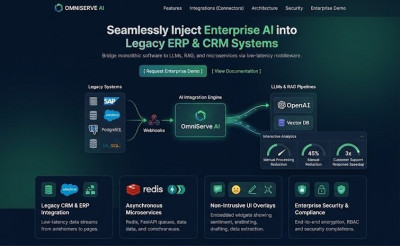
OmniServe AI – Enterprise ERP & CRM Integration Engine
Technologies Used:
PHP (Laravel framework), Python (FastAPI), JavaScript, jQuery, OpenAI API, PostgreSQL, Redis, RESTful Web APIs, WebhooksProject Type:
Middleware AI Integration Platform & Enterprise ConnectorProject Description:
Modern enterprises rely heavily on legacy software systems—such as legacy Enterprise Resource Planning (ERP) platforms, Customer Relationship Management (CRM) tools, and specialized helpdesk ticketing applications. While these systems remain the operational backbones of large organizations, they lack native modern artificial intelligence capabilities. Updating or replacing these monolithic stacks with native AI platforms is often prohibitively expensive, risky, and disruptive to daily business operations. OmniServe AI was developed specifically to solve this enterprise bottleneck. Designed as a flexible, non-intrusive AI Integration platform, OmniServe AI functions as an intelligent middleware ecosystem that embeds advanced natural language processing, predictive automation, and real-time semantic analysis directly into existing enterprise software stacks without requiring complete platform overhauls or costly database migrations.
The technical architecture of OmniServe AI emphasizes modularity, high throughput, and seamless API interoperability. Built on a robust PHP Laravel core to manage system state, tenant isolation, access controls, and administrative configurations, the engine handles complex webhook orchestrations from external CRMs and databases. To prevent latency on legacy frontends, all AI heavy lifting is offloaded to an asynchronous Python FastAPI microservice layer supported by Redis task queues. When an event occurs in a connected legacy system—such as an incoming customer support email or a modified inventory status—OmniServe AI captures the event payload via webhooks. The microservice pipeline tokenizes the data, applies Retrieval-Augmented Generation (RAG) using vectorized context stores, and queries OpenAI's Large Language Models to generate contextual action proposals, data extractions, or dynamic response drafts.
On the user interface side, OmniServe AI provides lightweight JavaScript and jQuery
integration widgets that inject directly into legacy web panels. Front-end users do not need to log into a separate portal; instead, dynamic sidebars and floating overlays appear within their familiar web environments. For instance, when a support agent views a ticket in an older web portal, the OmniServe widget automatically displays sentiment scores, suggested resolution steps, and pre-drafted replies synthesized from internal documentation. Furthermore, the backend integration automates field updates in PostgreSQL and remote databases via RESTful APIs. It automatically parses unstructured data—such as attached PDF invoices or unstructured email queries—and writes structured JSON output into the correct CRM records, eliminating manual data entry errors entirely.
Security, enterprise compliance, and operational reliability were paramount during development. OmniServe AI incorporates end-to-end encryption for data in transit and at rest, role-based access control (RBAC), and detailed audit logs tracking every automated action and model response. By delivering intelligent capabilities through a middleware integration layer rather than a full system replacement, client organizations achieved a 45% reduction in manual data processing time and a 3x speedup in customer support response cycles within weeks of deployment. Deployed via Docker containers and microservice pipelines, OmniServe AI proves that legacy systems can be transformed into cutting-edge, AI-powered enterprise engines safely, cost-effectively, and efficiently.